
Subscribe Now and Get Discount 10%
Be the first to learn about our latest trends

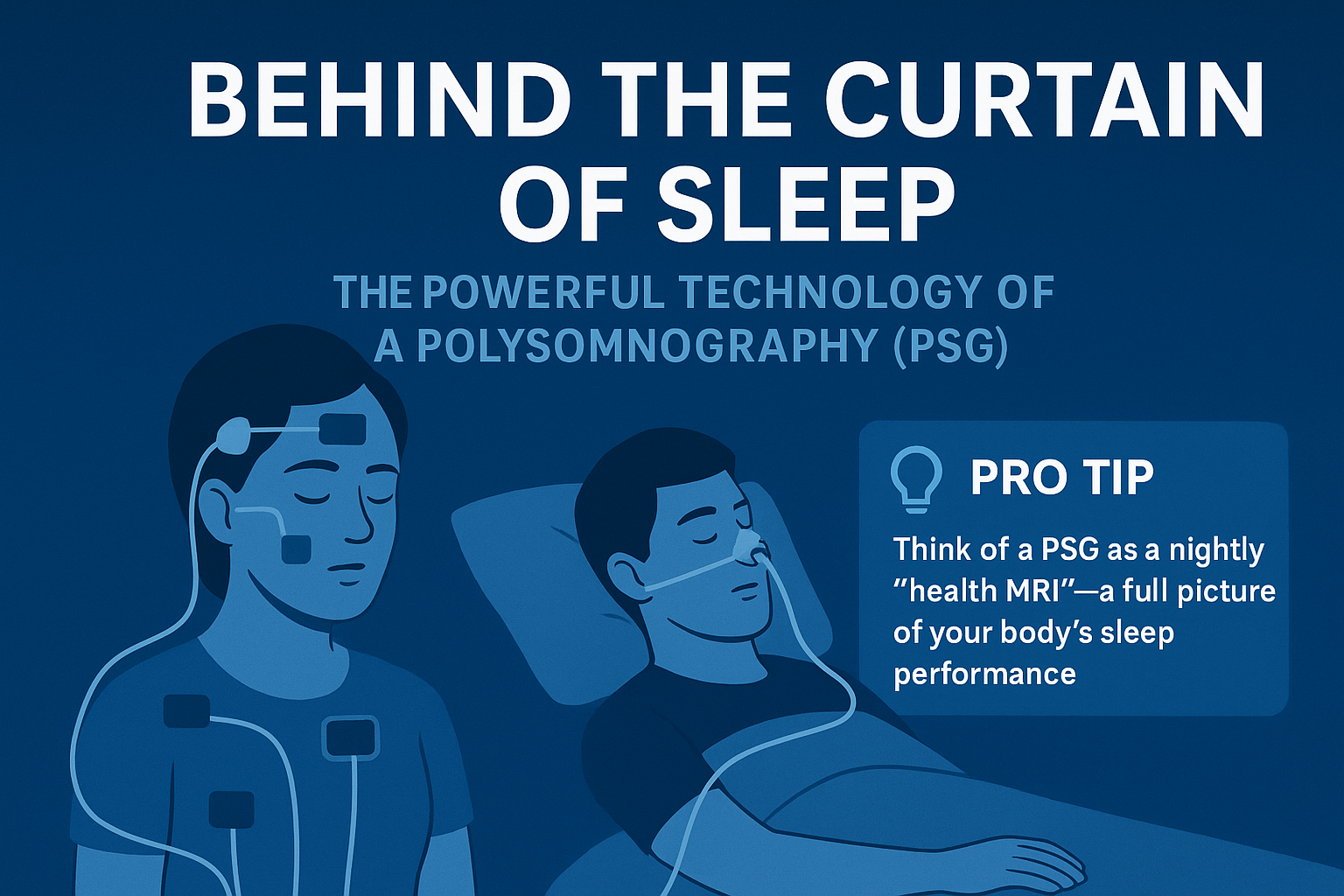
“Our content is where individuals preparing for a sleep study get a clear, comprehensive breakdown of what happens during a PSG and why it’s so effective, giving the confidence and peace of mind needed to undergo the test and get an accurate diagnosis”.
You’ve probably had an EKG to check your heart, and maybe an EEG to monitor brain waves. But what if there was one single test that could do all that—and more—while you sleep?
A sleep study (Polysomnography or PSG) isn’t just about snoring. It’s a multi-channel diagnostic tool creating a minute-by-minute map of your night. This map uncovers the unseen events sabotaging your rest and, by extension, your health.
Pro Tip Box:
Think of a PSG as a nightly “health MRI”—a full picture of your body’s sleep performance.
How does a PSG work? Painless sensors are attached to your body to monitor a symphony of physiological signals. Like an orchestra conductor listening to each instrument, the data from these channels allows doctors to identify sleep disorders with pinpoint accuracy.
Without this technical insight, conditions like sleep apnea, limb movements, or narcolepsy could remain hidden. Understanding what’s measured is the first step toward trusting the process and embracing a path to a proper diagnosis.
A PSG captures a wealth of data. Each channel provides a unique insight:
Brain Waves (EEG)
Eye Movements (EOG)
Muscle Activity (EMG)
Heart Rhythm (ECG)
Breathing Airflow (Nasal Pressure/Thermistor)
Chest & Abdomen Movement
Oxygen Saturation (Pulse Oximetry)
Highlight Box:
Each sensor is a detective—uncovering hidden interruptions in your nightly rest.
After data collection, a sleep technician scores the study. Here are the key metrics your doctor evaluates:
Total Sleep Time (TST) & Sleep Efficiency
Sleep/REM Latency
Apnea-Hypopnea Index (AHI)
Arousal Index (AI)
Mini-CTA Box:
Ask your doctor to explain your AHI and AI—they’re the keys to understanding your nightly health.
Step 1: Arrive at the sleep center; sensors are applied to scalp, face, chest, legs, and fingers.
Step 2: Technician monitors from another room, ensuring comfort and accuracy.
Step 3: Sleep naturally—no need to force patterns.
Step 4: Data is scored and analyzed; report prepared for your doctor.
Reader Tip Box:
Bring comfy clothes and avoid caffeine or heavy meals before the test. Small adjustments improve accuracy.
Facing a sleep study can feel intimidating, but knowing what happens behind the scenes offers peace of mind.
Every sensor and metric provides evidence for a precise diagnosis, paving the way for effective treatment. Whether it’s OSA, CSA, PLMs, or narcolepsy, the PSG is your tool for understanding—and improving—your sleep.
💬 Reader Engagement Box:
Are you ready to stop guessing about your sleep? Schedule a consultation, and share your biggest sleep question in the comments below!
CTA Box:
Take the first step to understanding your sleep tonight—book a consultation and embrace the science behind your rest.