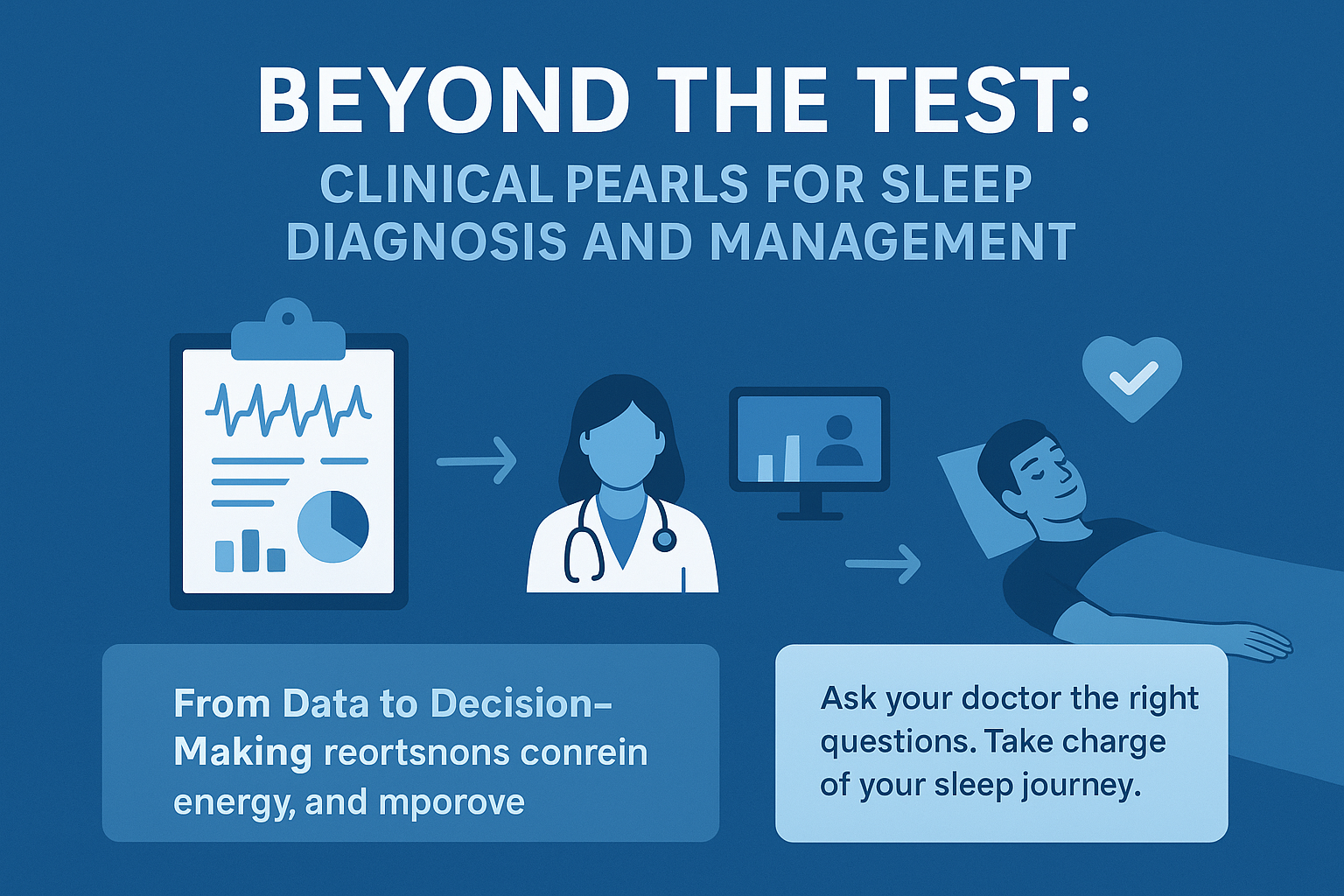
Beyond the Test: Clinical Pearls for Sleep Diagnosis and Management
“Our content is where individuals with a new sleep diagnosis or those considering a sleep study get expert-backed insights and a streamlined process for diagnosis and management, giving them the confidence to navigate the healthcare system and reclaim better health”
⚡ The Missing Link in Your Sleep Journey
You’ve probably heard of a sleep study, but what happens after the results come in?
The journey from diagnosis to effective treatment can feel like a maze, filled with questions about the right test, interpreting results, and identifying the most effective next steps.
For both patients and doctors, streamlining this process is a clinical art form.
It’s about more than just numbers— it’s about connecting the data to your
lived experience and ensuring that your care plan delivers real results.
Side Note:
Think of your sleep study as a map. The real goal? Finding the path that restores your energy, sharpens your focus, and improves your health.
🧩 From Data to Decision-Making
The attached diagram, titled “Clinical Practice Pearls,” reveals how expert interpretation transforms raw sleep data into actionable treatment plans.
These pearls highlight three crucial principles:
- Using the right diagnostic tool for the right patient
- Understanding the critical role of expert interpretation
- Ensuring ongoing consultation and follow-up
By knowing these guiding principles, you become an empowered partner in your healthcare journey, ensuring that every step aligns with a single goal: restorative, high-quality sleep.
Highlight Box:
Clinical pearls are not just technical details—they’re practical rules of thumb that guide effective sleep care and help you make informed decisions.
🔹 Section 1: The Right Diagnostic Tool for the Right Patient
One of the first pearls of sleep medicine is choosing the correct diagnostic test. While in-lab Polysomnography (PSG) is the gold standard, it’s not always the best fit for every patient.
Portable Sleep Studies (HSAT)
- Recommended for moderate-to-high risk OSA patients without significant comorbidities
- Convenient: Conducted in your own home, in a familiar sleep environment
- Cost-effective, faster turnaround
- Limitation: Not ideal for complex cases like narcolepsy or Central Sleep Apnea (CSA)
In-Lab Polysomnography (PSG)
- Most comprehensive test: monitors brain waves, eye movements, muscle activity, heart rhythm, and breathing
- Required for complex or multi-condition patients
- Provides the full picture for accurate diagnosis
Mini-CTA Box:
Ask your doctor: “Based on my symptoms, which type of sleep study is right for me and why?”
🔹 Section 2: The Art of Interpretation: Connecting Data to Symptoms
A raw sleep study report is just numbers and graphs. The real insight comes from expert interpretation: connecting clinical data to patient experience.
It’s Not Just About the AHI
- The Apnea-Hypopnea Index (AHI) is important but not the whole story
- Example: A patient with an AHI of 6 may still feel exhausted due to a high Arousal Index, which tracks how often the brain briefly wakes during sleep
Clinical Context Is King
- Symptoms matter: morning headaches, gasping sounds, daytime fatigue
- A skilled sleep physician considers both the data and your lived experience
- Treatment is tailored—not every number requires the same solution
What to Expect
- Specialists analyze sleep stages, heart rate, breathing patterns, and limb movements
- Findings are translated into an actionable, personalized plan
Side Note:
A good sleep doctor will never treat a number—they treat the patient.
🔹 Section 3: The Role of Specialist Referral
Complex cases or inadequate response to therapy often require a sleep specialist referral.
When to Refer
- Standard therapy (e.g., CPAP) is not resolving symptoms
- Complex disorders are suspected (CSA, idiopathic hypersomnia, narcolepsy)
- Co-existing medical conditions complicate treatment
Specialist Advantages
- Expertise in differentiating disorders
- Access to advanced therapies and precision titration studies
- Continuous follow-up to adjust therapy and optimize outcomes
Mini-CTA Box:
Unsure if you need a referral? Ask: “Are there advanced treatments or adjustments that could improve my sleep quality?”
🔹 Section 4: The Power of Documentation and Follow-Up
Good sleep management isn’t a single event—it’s a process.
Clear Records Are Crucial
- Maintain copies of your sleep study reports, titration settings, and treatment history
- Essential for insurance, future care, and long-term monitoring
Follow-Up Titration Studies
- Especially important for CPAP users
- Ensures optimal pressure settings for effective therapy
- Monitors treatment success and adherence
Takeaway
- Documentation + follow-up = more effective therapy and safer, sustainable outcomes
- Always review your results and keep your own records
Highlight Box:
Knowledge is power. Keeping track of your results helps you advocate for yourself and ensures your treatment is precise and effective.
🌟 Kicker: Your Next Step to a Restful Life
Navigating sleep diagnostics doesn’t have to feel overwhelming. By applying these clinical pearls, you gain:
- Clarity about your diagnosis
- Confidence in interpreting results
- Control over your treatment journey
Mini-CTA Box:
What’s one thing you now know to ask your doctor or sleep specialist? Share it in the comments and start the conversation.
Remember: A sleep study is not just a test—it’s a tool to reclaim your nights, your energy, and your life.
✅ Key Takeaways
- Choosing the right test ensures accurate, relevant data
- Expert interpretation is critical—numbers alone don’t tell the full story
- Specialist referrals are important for complex or unresolved cases
- Documentation and follow-up maximize therapy effectiveness
- You are an active participant, not just a patient
Highlight Box:
Mastering these clinical pearls transforms the sleep journey from confusing to empowering.